The Voyage

Spectacles

Andy and Melissa are sailing around the world on their 48-foot sailboat, Spectacle.

The Position

Bali, Indonesia

The Pictures

The Voyage of Spectacle

Land HO! The Approach to Fatu Hiva

Posted by: melissa

As if three weeks at sea with no land, no boats, no nothing wasn’t weird enough, finally seeing land — in the form of a hulking volcanic rock soaring out of the deep Pacific Ocean literally in the middle of nowhere — was even weirder.  Andy woke me at 5:00 a.m. for my watch, and he decided to stay up in anticipation of making landfall some time shortly after dawn.  About two hours later, a distant cluster of clouds off the port side bow began to reveal something other than infinite ocean and sky.  Land ho.  I almost started to cry, but I was too tired.

The striking beauty, but unfriendly terrain, of Fatu Hiva definitely added to the experience.  Imagine a 16th-century explorer, after weeks at sea in treacherous conditions, finding Fatu Hiva with its steep cliffs and headlands plunging sharply into the ocean with no beach or landing anywhere.  Luckily, we have charts and GPS to tell us where to anchor the boat.

The crew began to get very excited.  Coming closer, Spectacle rounded the island’s northwest corner and entered the lee of the island.  The seas went completely calm, and the water resembled a lake instead of an ocean.  As we came around the headland preceding the anchorage, we were agog at the striking beauty of the Bay of Virgins.  Eight yachts were anchored there already, including a couple we had met before.  Many emerged from below to welcome us and give us a hint on where to drop the hook for trusty holding during our inevitable walk on land and extended sleep.  The bay is quite deep, but with good holding, super-calm water, light wind, and plenty of good Samaritans, we were not too worried about dragging.    

We picked a nice spot towards the southeast corner of the bay and dropped the anchor in some sixty feet of water.  Andy went for a sleep since he had been up most of the night, and Ian and I took some relative bearings for anchor watch.  Satisfied with the holding, we just marveled at our surroundings … goats bleating on the hillside, a breeze blowing through the lush flora, an occasional coconut floating by, and the bluest sky I’ve ever seen.  It was truly a magical morning.

A Truly Eventful Day

Posted by: melissa

Experienced sailors call the Pacific crossing “the milk run” because it’s notoriously easy, calm, and mundane (touch wood).  Well, today has been anything but mundane!

First of all, we had a bad night.  After the fishing disappointment, some weather and swell started up that was markedly un-Pacific.  Ian spent his watch dodging about 6 squalls that kept causing the wind to change.  Andy’s watch was also extremely rough with erratic rolling swells that we couldn’t quite manage to consistently take on the quarter (which is much more comfortable than square on the beam).  Andy also fashioned a truly fantastic boom lashing solution which secures the previously squeaking and moaning boom totally still.  Even with the constant noise diminished, everyone still slept badly.

Even so, watches must go on!  Later, Ian spotted something off the portside bow about three-quarters of a mile away, and said, “whale.”  I looked out and sure enough, a huge gray-colored whale was swimming and spouting along.  Although we were awed, whales in this part of the ocean can be aggressive, so first and foremost, we tracked its course, and changed our own heading to steer quite clear.  (Ironically, Ian was reading “In the Heart of the Sea” at the time).  I then woke Andy, and grabbed the camera.  The shot is a bit Loch Ness-like in its blurriness so you’ll just have to take my word for it.  From the color and size and angled spout, we’re sure that it was a sperm whale.

Later, we were just about to dig in to Ian’s spaghetti Bolognese for dinner.  Ian looked forward, his eyes got really big, and he said an expletive.  I think Andy can take it from here….

Next Stop — Fatu Hiva, Marquesas

Posted by: melissa

After a rather acrimonious wrap up in the Galapagos, we pulled up the stern and bow anchors and headed off to cross big blue about 1:00 p.m. two days ago.  I must say that it’s a weird feeling to leave harbor (and in this case, a very rustic harbor) knowing that there’s no land for 3000 miles.  I kept saying, “I can’t believe we’re leaving right now for a 3-week passage.”  Most of our closest friends and family know that we’ve been anxious to get this leg of our journey out the way, so as weird as it is to go to sea for a minimum of 3 weeks, I’m still eager to get to the South Pacific.

Day 2 presented some really sublime sailing … calm seas, consistent wind, sunny skies, temperate weather.  At dawn, I was enjoying my morning coffee after just taking over watch from Andy when a huge pod of dolphins crossed the bow.  There must have been a thousand of them leaping and bounding.  It was a wonderful beginning to a nice day.

After watching scads of flying fish scurrying about all day long, we felt pretty confident that predators lie below us.  One flying fish actually flew onto the boat, ricocheted off the boom, and flew into the cockpit giving us all quite a start.  Later in the day, I thought I saw another pod of dolphins swimming alongside the boat this time.  I peeked over to watch them swim, and then began to wonder why they weren’t surfacing at all.  Upon closer review, I realized that they were not dolphins at all, but yellow fin tuna.  Huge massive 4-feet long yellow fin tuna … at least 10 of them. 

Andy put lines out immediately, but he only succeeded in losing one lure to an unseen leviathan and having another fish (a sizeable wahoo) break free just as we were trying to land it.  So far, it’s Fish 2, Andy 0.

Off to Scuba Dive the Galapagos Via Quito, Ecuador

Posted by: melissa

Live-aboard scuba diving trips in the Galapagos are extremely exclusive, and becoming even more so.  It appears that the Ecuadorian government struggles with the delicate balance between conservation, a thriving tourism industry, increased outside investment in the tourism industry, and financial quality of life for local Galapaguenos (is that a word?).  I would like to think that all aspects of the Galapagos’ well-being are strategic and defensible, but some areas felt pretty arbitrary (more on this later).  Even as I was trying to book this gig in September of 2007, several dive boats (and cruise ships) had not yet received their commercial clearance to operate in 2008.  Others who were confident of their upcoming clearance indicated that they had been booked for 18 months at least.

I finally found an opening where a single female passenger travelling alone needed a roommate, and a single male passenger travelling alone needed a roommate.  What are the odds?  We totally lucked out.  When the dust settled and the government doled out operator’s licenses, the boat I booked (Sky Dancer) was not only approved but was the only boat approved for the remote islands of Wolf and Darwin.  Total score.

Our plan all along was to sail to the Galapagos, anchor the boat, find a boat-sitter and head out on the live-aboard.  Because of the battery mishap, this was no longer in the cards, and, honestly, I was a bit relieved.  First, we weren’t familiar with the anchorages, and I anticipated the nightmares of Spectacle crashing against the rocks as we swam with dolphins.  Second, I kind of liked the idea of having the same experience as any other traveler.  And so, I booked our flights from Panama City, Panama knowing that Spectacle was safe and sound in the Flamenco Marina with Ian.

Quito, Ecuador was our jumping off point to get to the Galapagos.  The flight from mainland Ecuador to the Galapagos is only about 90 minutes, but the flights are structured so an overnight in either Quito or Guayaquil is mandatory on both the front-end and back-end of the trip.  This may have something to do with the scheduling of the inevitable international flights, but I doubt it.

The approach to the Quito was fairly hair-raising. At 9,350 feet, Quito is surrounded by (active and inactive) volcanoes and mountainous peaks, some of which seemed to be right outside the plane window.  With a population of 1.5 million, many of these peaks are covered with urban sprawl that soars to heights of 13,000 feet.  The first thing I did after retrieving the luggage was scrounge through my suitcase to find the only warm clothing item I packed.  I had figured, hey, it’s Ecuador, as in the Equator, right?  But, it was quite cold with a fairly constant drizzly rain.
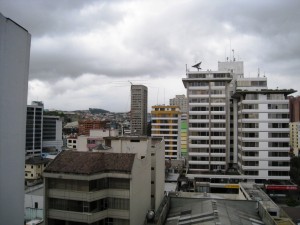
The View From Our Hotel in QuitoWe got to the hotel with minimal problems, but it was a Sunday and, true to our experience in most Latin American countries, the streets were deserted.  That left the inevitable hustle and bustle of this city to our imaginations.  It is very urban, but in a squatty boxy kind of way.  The architecture left quite a bit to be desired … cement-block, totally symmetrical, short storied, flat roofs, very Soviet in a way, but with some pastel-colored paint every once in a while, and lacking ornamentation of any kind (no patios, no windowsills, no roof overhangs, no awnings, no stoops, no pillars, no nothing).

The hotel was quite nice, with professional English-speaking staff.  Unfortunately, we went up to the room to find it a) not exactly what brochure purported, and b) full of someone else’s luggage.  Alas another “Wolf” registered at the hotel!  Mistake corrected, we were very happy to find our room in the recently refurbished wing of the hotel which was a lot nicer than the other “Wolf” room.  The view was pretty bleak … lots of urban sprawl and most of it just teetering on the edge of disrepair.

By this time, it was about 3:00 p.m. and we were hungry so we ventured out.  We walked around several blocks just meandering, but it was Sunday so we decided to just park it in the first place we found open.  We sat down at a little restaurant that was serving local food, found a table on their small patio, and ordered up a couple of Ecuadorian beers and (after stumbling through some Spanish) several Ecuadorian culinary specialties.  The one good thing I can say about Pilsener is that it’s large, and it’s better served very very cold, which it rarely is much to our chagrin.  The food was pretty interesting — lots of it, extremely fried, cheap, and served with pride and enthusiasm … what’s better than that?Uribe Graffitti in Quito
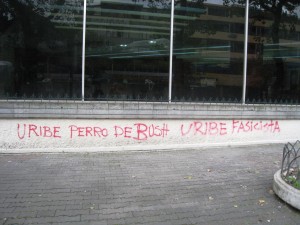
While walking around, we noticed a lot of anti-Uribe graffiti.  The Colombia military recently crossed the border into Ecuador to assassinate a known ranking FARC officer.  While Ecuador was pretty vocal in objecting to the infraction, I got the sense that most found Uribe’s actions to be impolite rather than anything more menacing than that.  But, as usual throughout the world, any associations with George W. Bush are poorly received.  For those of you not well versed en Espanol, “perro” means “dog” and “de” means “of.”

After lunch, we headed out to see the sights.  Basilica del Voto Nacional, consecrated in 1892, is renown for its grotesques.  We peeked in on a lovely wedding in progress, and then sat in the park gazing at seemingly endless hillsides of urban sprawl.  From the park, we caught a glance of ‘La Virgen de Quito,’ a statue of the Madonna on top of a globe and stepping on a snake.  The historic center of town is one of the first UNESCO World Heritage Cultural Sights (along with Krakow, Poland), so named in 1978.  We saw some nice streets with nice buildings, interspersed with establishments such as “Texas Chicken.”  Independence Plaza is a two acre, pedestrian-only park surrounded by cafes, statues, fountains, and government buildings, including the presidential palace.  We didn’t see too many tourists, but we did chat with several friendly passers-by who seemed happy to see Americans.

After this whirlwind tour of Quito, we headed back to the hotel and watched Anthony Bourdain on The Travel Channel (yes, we miss television, withhold judgment please) who was covering a timely subject … the Marquesas and the Tuamotus.  Next we watched the NCAA Final Four and chuckled at UCLA’s defeat.


Type I Error

Posted by: andy

For any of you who had the pleasure of taking Statistics 150 at Mizzou or its equivalent elsewhere, you might recall the concept of Type I and Type II errors.

Basically, a Type II error is, in boating as in most walks of life, the more common mistake:  underinclusivity, the failure to include relevant data, or, if you will, the failure to recognize a particular extant problem — a false negative.

A Type I error is a mistake far less common in boating:  overinclusivity, the inclusion of irrelevant/erroneous data, or, if you will, identifying as extant a problem which does not in fact exist — a false positive.

Let’s make this simple –

Not knowing that the Japanese were going to bomb Pearl Harbor — Type II error.

Erroneously assuming Iraq had weapons of mass destruction — Type I error.

OK, even more simple.

When the pregnancy test says you aren’t pregnant and you actually are – Type II error.
When the pregnancy test says you are pregnant and you really aren’t – Type I error.

See the difference?

Not being the most experienced sailors, we commit Type II errors all the time.  The Tale of the Twin Fiascoes was basically one Type II error after another – not filling up the gas tank, thinking we had a handheld VHF but not actually having one, not turning off the electronics once we were out of fuel, etc., etc., etc.

Well, I’ve finally committed my first major Type I error.  And it was a doozy…

For about the last two weeks, I’ve been convinced that our batteries were, for whatever reason, failing adequately to retain charge.  Following test after test, the reading of endless manuals (probably could have done some more of that earlier) and even the hiring of a largely clueless electrician, I have now diagnosed the situation:  there is nothing now wrong, nor has there recently been anything wrong, with our batteries.  Instead, there is something wrong with my powers of diagnosis.

This episode would be at bit more humorous if it weren’t so badly timed.  Having improbably cleared every hurdle in our mad scramble to meet our deadline, we actually found ourselves all set – the boat was all ready to go to the Galapagos and we could have left on time in ideal conditions (the weather was absolutely perfect), saved ourselves a couple of thousand dollars in airfare and attendant travel hassles and had an extra two weeks in the South Pacific.  So, yeah, um …