The Voyage

Spectacles

Andy and Melissa are sailing around the world on their 48-foot sailboat, Spectacle.

The Position

Colombo, Sri Lanka (Boat in Brisbane)

The Pictures

The Voyage of Spectacle

Archive for the ‘Beaches’ Category

Turks and Caicos

Posted by: melissa

Well, Turks and Caicos was not part of our original plan; nonetheless, we are definitely making the most of this unscheduled stop (in work and play)!

With 8 islands and a bunch of smaller cays, the Turks and Caicos Sapodilly Bay, Turks & CaicosIslands (TCI) are located on the southeastern tip of the Bahamian archipelago about 575 miles southeast of Miami and 100 miles north of Haiti.  The name Caicos may have been derived from the Spanish word for ‘cay’ (cayos), and the name Turks is believed to come from the resemblance of an indigenous cactus’ red dome to a fez.  Both Grand Turk and the Caicos islands are low altitude, scrub-covered limestone with huge coral reefs and striking turquoise water.

Our current port, Providenciales (Provo) is the most developed and populous island of the Turks and Caicos Islands.  Local legend says that Providenciales was named in the mid-18th century by the survivors of a shipwrecked French boat called La Providencielle.

Provo’s residents are a combination of native islanders (called “Belongers”), American, European, and Canadian expats, Haitians, and Dominicans.  Even with the diverse cultures, Provo is decidedly Americanized due to the development boom, increasing tourist industry, and rapid decline of other industries.  Throughout our stay, we sought out native food, activity, and entertainment … to no avail.  Though totally Americanized, Provo has no American fast food restaurants, which is quite refreshing.

Tourism is alive and well here as huge resorts and timeshare condominiums clutter the Beautiful Ocean Around Turks & Caicoscoastline.  It is our understanding that TCI is the destination of the rich and famous (evidently home to a Keith Richards lair) and prices definitely reflect that.  After experiencing a lot of what Provo has to offer, we probably would not recommend that you spend your hard earned dollars on the $850 average nightly room rate (with a 10 night mandatory minimum stay) at the big three resorts of Grace Bay Club, The Palms and Point Grace.  Don’t get me wrong, the beaches are fantastic, and some of the resorts are very nice … but I get the sense that most tourist things here are at least 20% overpriced.  From a value perspective, go to the Grand Wailea on Maui, or the Princeville Resort on Kauai … Hawaii may be a more crowded but a lot cheaper for comparable, or better, amenities.

When we were researching Turks and Caicos for trip planning purposes, we consulted Tripadvisor.com (we never leave home without doing so).  Most of the reviews were positive but with two major complaints: prices (which I’ve already talked about) and mosquitoes.  I expected the latter to be a bit silly or the kind of nitpicky complaint that some Tripadvisor.com users get so worked up about … I mean, really — it’s a tropical environment and there are gonna be some bugs.  As it turns out, it’s a valid complaint — the mosquitoes are plentiful and unusually vicious!

Around 4:00 or 5:00 p.m., we usually head out on the frightening dirt road towards the super fancy Grace Bay.  We’ve crashed just about all of the swanky resorts and since there’s really no such thing as the traditional “hotel lobby” here, we have peeked in the windows of ground floor rooms and condos to gauge how each swanky resort actually compares to the others (we think Point Grace might be the winner).  Plus, we’ve been to almost every restaurant in Grace Bay, from the swanky restaurants at the “Big Three” resorts down to the Irish Pub (where not a single Notre Dame fan was available to be taunted by Andy during the Sugar Bowl), Bella Luna (a decent Italian restaurant with a highly coveted taleggio appetizer), and the very cute Barefoot Café located below the yoga studio.

Jost van Dyke

Posted by: andy

We decided to leave Tortola around 2:30 p.m. yesterday and head for Jost van Dyke, the nearby “out island” that is home to two legendary beach bars – Foxy’s and Soggy Dollar Bar — and very little else.  The thought was that we’d get to JvD around 4:30, anchor the boat, dinghy ashore, check out of BVI customs and immigration, have dinner and a few drinks at Foxy’s, dinghy back out to the boat, and sail overnight to St. Martin.

We actually managed to get off the dock just after 2:30.  It was strange saying good-bye to three different boats we had encountered in multiple locations already, knowing that, this time, we were unlikely to see them again.  I suppose we should get used to that.

Having FINALLY gotten our batteries replaced, we now no longer need to be tied to something hard – we can finally “anchor out” like proper sailors.

Anchoring is surprisingly difficult for many, many sailor – it is probably the one thing that most boat owners are slightly afraid of, and for good reason.  People often times make complete … well … spectacles of themselves as they attempt to park the boat.

I am pleased to report that our maiden anchoring was absolutely flawless.  We planned it out well and executed it perfectly.  This was a strong point for each of us back in sailing school, and, apparently, we remember what we were taught.

Our maiden post-anchoring dinghy ride, however, was not so flawless.  We managed to get the dinghy to Foxy’s dock right at 5:00.  Melissa jumped off and sprinted for customs.  Alas, we had missed them.  So, we’d have to stay overnight – no big deal.  St. Martin can wait one more day.

Foxy’s might be the single most-famous beach bar in the entire Caribbean, if not the world.  We felt like we “needed to do it” but expected to be put off by excess commercialism in the vein of Hard Rock Café.  Boy, were we wrong.

The Infamous Foxy's at Jost van Dyke, BVIYes, it has a very large T-shirt shop/boutique, and they do a very brisk business.  But Foxy’s puts out a tremendous product.  The bar is great.  The drinks are creative and tasty.  The staff is fantastic and professional, and the food was surprisingly delicious.  We were a little bit hesitant to pay $28 apiece for a “Beach BBQ,” but this was fantastic food – ribs of near-Twin Anchors quality, the best jerk chicken either of us have ever had, corn that was downright memorable (now that’s saying something).  It was a bargain at twice the price.  Foxy’s certainly doesn’t need me to tell you how great it is.  The word is already out.  But it isn’t popular by accident.

“Several” (ahem) Dread Fox cocktails later, we walked down to the dock to get on the dinghy and head back to the boat.

It was sinking.  Seriously – it was SINKING!  The left pontoon was basically flat and submerged.  We got into the boat, thinking we might just be able to make it back to Spectacle.  Totally wrong.  All we did was make it worse, instantly.

Melissa jumped back on the dock, losing a flip-flop, grabbed the waterproof bag, as we prepared to “save” the outboard.  I jumped into the water … which, thankfully, was only about four feet deep.  I managed to wrestle the outboard off the boat and onto the dock, and we eventually retrieved the boat as well and dragged it onto the beach.  However, it’s pretty clear that we’ve got a fairly meaningful “slow leak” in the dinghy (and not that slow, apparently).  Add that to the list of repairs.

We caught a ride out to the boat, slept pretty well (no paranoid middle-of-the-night dashes on deck to check the anchor), and caught a ride back in the next morning.  After reinflating the dinghy and checking out of customs, we marched (sans dinghy) over the hill to Soggy Dollar Bar.  This was quite a hot, steep and lengthy shlep, but it was worth it.  The bar is not really the allure – it’s just ok.  The beach, however, is fantastic.  We put away a few Painkillers, opted for a cab (pretty tough to find on a tiny island) back to Foxy’s, and managed to get the dinghy towed back out to Spectacle.  Then we put the dinghy on the davits, pulled up the anchor, and headed off for an overnight sail to St. Martin.  More Pictures

Martinique, French West Indies

Posted by: melissa

Volcanic in origin and surrounded by coral limestone reefs in the south, Martinique’s 416 total square miles resembles a right-handed mitten anchored in the north by the ominous 4,656 foot Mont Pele.  Martinique is centrally located in the Eastern Caribbean chain between the windward islands of Dominica and St. Lucia.  With a population of 430,000, Martinique is the second most populous island in the Lesser Antilles after Trinidad.  About one-third of the total population resides in Fort de France, Martinique’s capital city on the west coast.

Columbus discovered Martinique in 1502 but did not establish a colony, leaving the indigenous Caribs The Approach to the Very Beautiful Island of Martiniquetemporarily undisturbed.  In 1635, a group of about 100 French colonizers came from St. Kitts, settling on the western coast in the area later known as St. Pierre.  The colony built a fort, planted crops, and after many violent skirmishes, struck a truce with the Caribs to peacefully coexist on opposite sides of the island.  The 1650’s were enormously profitable for the French colony based on the shipping of agricultural goods to Europe, most notably sugar cane to France.  The roots of Martinique’s unusual, love/hate relationship with France began with this early colony … especially when a governor unsuccessfully attempted to enforce the Exclusif, an unpopular law prohibiting trade from Martinique to anywhere but France.
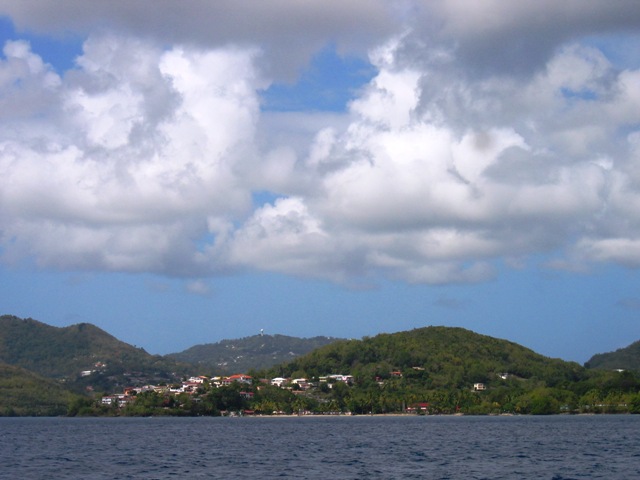
The Approach to the Very Beautiful Island of MartiniqueLike most of the Caribbean islands, Martinique changed hands several times.  In the 1700’s, the British gained interest in the rich and strategically placed island causing a struggle nearly two centuries long.  Even so, Martinique enjoyed relative political stability (for more than 20 years under the British flag) and avoided much of the chaos experienced in Guadeloupe and St. Domingue (which would become Haiti after North America’s only successful slave rebellion establishing a black republic).

The French reacquired Martinique for good in 1815 under the Vienna Treaty; however, the return to French rule was bittersweet for islanders due to France’s continued endorsement of slavery.  Sadly, it was Martinique’s own favorite daughter, Marie-Rose Josephine Tascher de la Pagerie, better known as the Empress Bride of Napoleon Bonaparte, who was behind the reintroduction of slavery in Martinique.  After several slave riots, Victor Schoelcher mobilized the anti-slavery movement and abolition was declared in 1848.
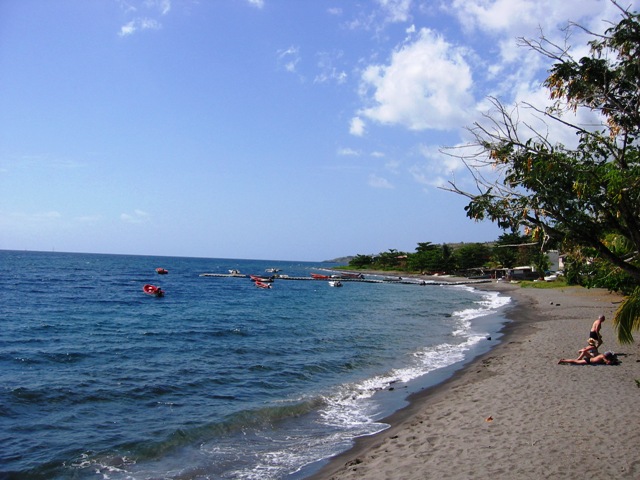
Martinique's Black Sand Beaches Towards the NorthMartinique is a spectacularly beautiful island.  The imposing rocky cliffs in the north soften to rolling hills of lush rainforest, endless acres of banana trees, and sugar cane swaying rhythmically in the ocean breeze.  The southern beaches enjoy crystal blue water and white sand beaches while the sand becomes increasingly darker and striking towards the more volcanic north.
Rodney Bay Marina and Other Observations

Posted by: melissa

Rodney Bay is turning out to be a really nice marina.  Its location in a protected lagoon keeps the boat very flat, with the exception of the wake from marina employees zipping around in small power boats (about which I complain to no end).  We heard a rumor that the marina will be receiving a major overhaul to include new washroom facilities and even fancy floating docks.  The latter would definitely be helpful since tide change can make boat entry and exit difficult during some parts of the day.  As a matter of fact, I nearly went for a swim while jumping off the boat on our way to the airport to go to Trinidad.  It was SO CLOSE!  The dock was much lower than the boat’s deck, and when I jumped, I fell down, flipped backwards ass over tea kettle, and very nearly rolled backwards into the nasty marina water.  I personally thank Pilates for stopping my backward momentum!

The marina also seems to be a hub for a lot of circumnavigators and seasonal yachters, so we’ve met many fun and interesting people.  Additionally, the World Cup tourists have provided an international flair as well.  I typically like sporting events since sports fans can be so lively and delightfully competitive and passionate.  If you don’t believe me, go hang out in Pasadena during the Rose Bowl game, or go to the city that’s hosting the Super Bowl, and you will see some fun (and slightly crazy) people!  St. Lucia was crawling with cricket super fans crazy enough to follow their team half way around the world.  Very fun!

Nevertheless, a marina closer to the “real action” of St. Lucia (i.e. the pitons, fancier parts of the island, more renowned beaches, etc.) might be an improvement.  On this point, we probably differ from most yacht people in that we want to go to The Plantation Room at Jalousie or Dasheene at Ladera to clean out the wine list and sample the island’s finest dining establishments, but the driving proves difficult both in time and effort.  I find driving through Castries to be particularly harrowing, especially when a cruise ship is in port, which is nearly always.  Combine confusing and one-way streets with T-shirt-shopping-crazed, cruise-ship tourists on a deadline with speeding and rude local drivers … panic is inevitable!

Arrival in Gold Coast — Welcome to Queensland!

Posted by: melissa

Well, during the passage from Coffs Harbour to Gold Coast, we passed two milestones.  First, we said goodbye to New South Wales, and hello to Queensland.  Second, we left the latitude of 30 and higher behind us.  I am relieved to have re-entered the milder waters and warmer temperatures of the 20s … equator, here we come!

Our departure from Coffs Harbour was delayed by a couple of hours because of the tide.  Low water was at 10:30 a.m. so we waited until noon to give ourselves some leeway.  Plus, Coffs Harbour was hit hard by a recent storm that pounded the harbor and damaged the marina.  The channel entrance was still undergoing some redredging as part of the recovery. 

We went through the breakwater and headed offshore slightly, but only about 2-3 miles to try and avoid current.  As night fell however, we started seeing more and more fishing vessels, and we were forced to go further out away from the coastline to stay out of traffic.  The wind completely died and we were forced to motor as well. 

At dawn, we passed by Byron’s Bay which is the eastern most point of Australia.  By that time, I was heavily into my next book, The Girl with the Dragon Tattoo, which is a plot driven page turner which is nice on long passages.  Andy highly recommended it, as well as the sequel called The Girl Who Played with Fire.  Evidently there’s a third in this Stieg Larsson trilogy, but we don’t have it onboard. 

Anyway, I was totally engrossed when a humpback whale surfaced and blew its spout less than 50 yards away from the boat.  It was startling, but so incredible.  We’ve seen a lot of whales now, and it never gets old.  It’s just amazing to experience such a rare and exotic animal in such natural way … no tour group, no whale-watching guides, no throwing food in the water … just observing a whale doing what whales do, and have instinctually done, for millions of years.  Being that close is like meeting a dinosaur or something.  It’s awesome, in the truest definition of the word.

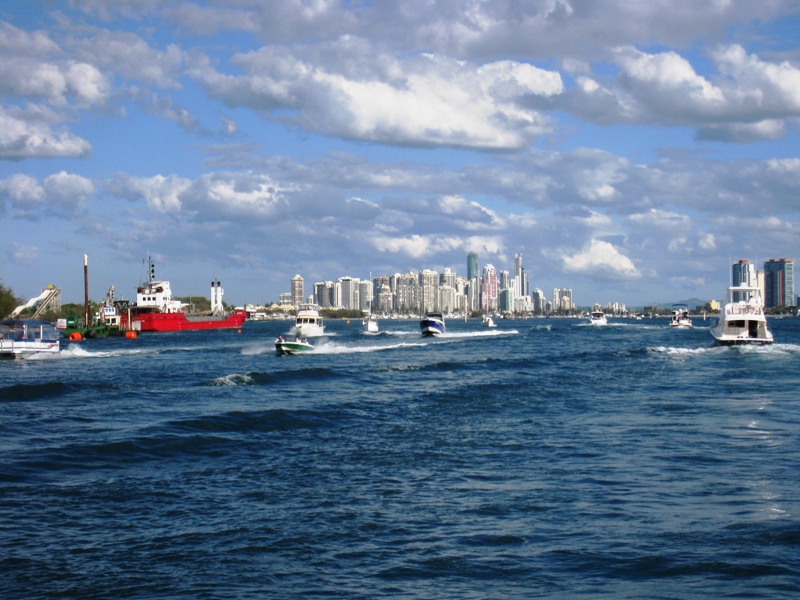
The sun was shining and as predicted, the weather was really warming up.  I may be able to put away my Newcastle Knights hat and scarf for good shortly!  Unfortunately, 20 knots of wind turned right on the nose, so it looked like motoring the rest of the way.  Gold Coast and Surfers Paradise were quickly in view — it looks like Miami with sky rises and huge white sand beaches. 

The approach to Gold Coast was pretty chaotic.

The approach to Gold Coast was pretty chaotic.

We located the channel entrance mostly by following the 30 or so boats heading in after a Sunday afternoon on the water.  The currents going over the sandbar were weird enough, but the wakes of macho, speed demon, power boats bounced us around as well.  Dinghies, jet skis, fishing boats, whale-watching power catamarans, party barges … it was pretty much total chaos.  But, we turned the corner and followed the very distinct aids to navigation, easily found the marina, filled up with diesel, found our slip, and settled in.