
Menswear
Sherwani
A sherwani is knee-length (or longer), long-sleeved, tailored, close-fitted coat with hidden buttons down the front. One defining feature of a sherwani is the “mandarin” collar, also known as a “Nehru” collar, which is a short collar that stands straight instead of folding over. Origins of the sherwani date back to the court uniform of Turkish and Persian nobles in the Delhi Sultanate and Mughal Empire. The sherwani gained popularity in colonial India in the 18th century as a fusion of the traditional salweer kameez with the British frock coat. It was the official dress code in the court of the Nizam of Hyderabad, and it is the national dress for men in Pakistan as it is not associated with any one particular province. The sherwani is extremely popular particularly in northern India for grooms and party-goers.Â
Official sherwanis are typically single-hued, but formal sherwanis run the full range from very plain to highly ornate with beads, embroidery, and other flashy embellishments particularly along the buttoned front and the collar. Fabrics are usually heavier and always lined similar to a western suit.Â
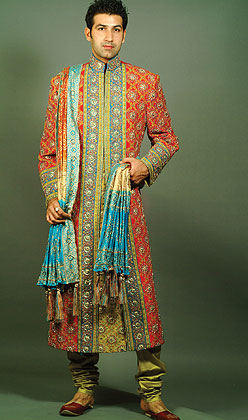
Sherwani with Churidar, Shawl, and Khussa Shoes
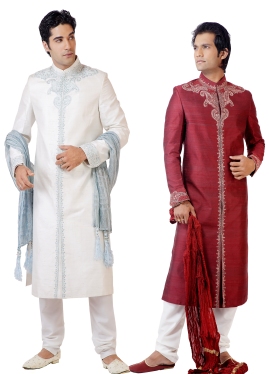
Sherwani
Â
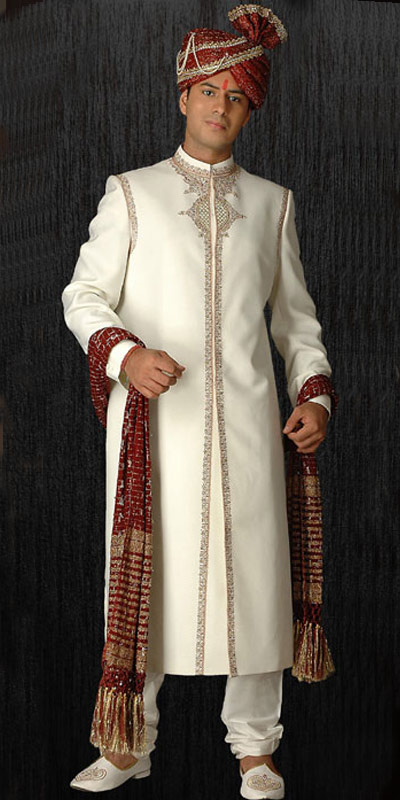
Sherwani with Indian Turban, Churidar, Shawl, and Khussa Shoes
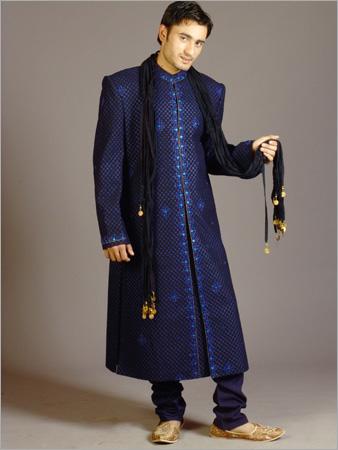
Sherwani with Churidar, Shawl, and Khussa Shoes
Kurta
The word, kurta, is derived from old Persian meaning “collarless shirt.” It is a long (approximately knee-length), loose-fitting shirt worn by both men and women (sometimes called kurti for women) as casual everyday wear or formal wear. A typical kurta is simply made up of two rectangular pieces of fabric perhaps with a few gusset inserts. The side seams are left open anywhere from 6-12 inches above the bottom hem to provide for ease of movement. The traditional kurta has a round and collarless neckline, and long sleeves that fall straight to the wrist without tapering. But in modern styles, almost anything goes. Sleeves range in length from long-sleeved to sleeveless, flared or tapered, even cuffed. Necklines can be V-neck, scoop-neck, mandarin collar and everything in between. A kurta can be a pull-over, a partial button-up, or a full button-up.Â
Usually, kurtas are lightweight cotton, silk, or satin to suit hot and balmy conditions, but thicker materials like wool and coarse handspun silk are used in cooler climates as well. Many view the simple cotton kurta in a neutral color as a very dignified look donned by elders, and various political, religious, and business leaders. Like sherwanis, styles range the full gamut from plain to intricate. A kurta can be worn over a salwar, churidar, sarong, or even a western-style pant like jeans or trousers.Â
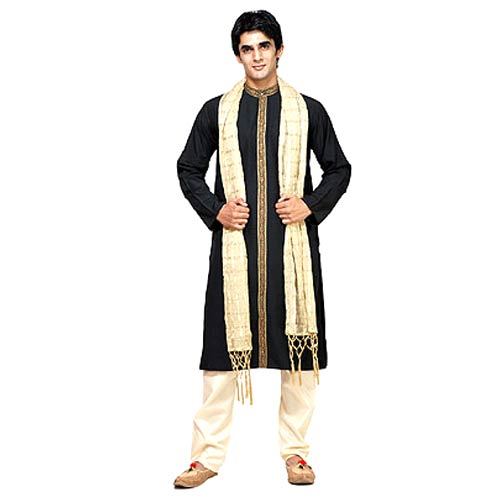
Kurta with Salwar, Shawl, and Khussa Shoes
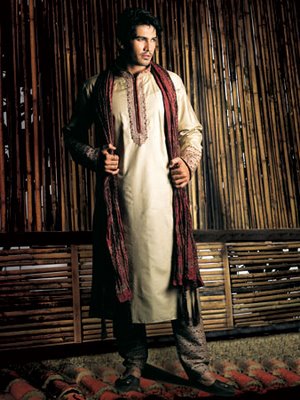
Kurta with Salwar and Shawl
Â

Kurta with Churidar
Â
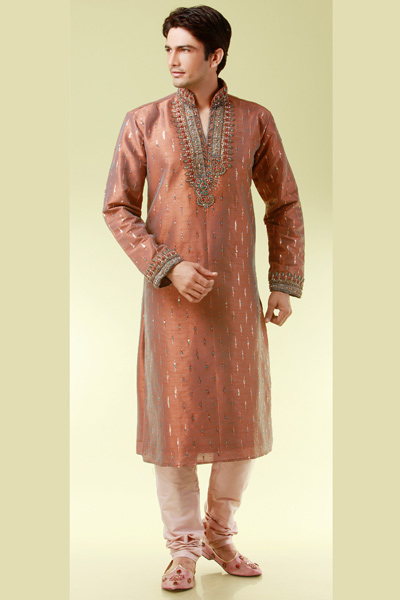
Kurta with Churidar and Khussa Shoes
Â
Salwar and Churidar
A salwar is a pajama-like, loose-fitting pair of drawstring pants cut wide and baggy across the waits, hips, and thighs, and falls straight, or gradually tapers, to the ankle. A churidar is similar, except this form of pant dramatically tapers from the knees to the ankles. The pant legs of the churidar are longer than the wearer’s legs, so the bottom of the pants crumple and slouch around the ankles giving the appearance of bangles, or “churis.” Both salwars and churidars are basically one-size-fits-all and are very frequently sold as coordinated sets with matching tops.
Recommendations for Menswear
Size 44 or Smaller
Dressing the men has become a bit difficult since Sri Lankan men are smaller in stature than American men. Unfortunately, the largest jacket size available off the rack is a pretty slim 44.Â
If you are comfortable with a size 44, and you are around on Sunday, March 14, you are welcome to tag along on the shopping tour and select something off the rack. There are plenty of available options sized 44 or smaller. If you’re not into shopping, I’m happy to pick out something for you beforehand so you don’t have to suffer through the shopping trip.
Because it is a tailored jacket, sherwanis can be quite expensive usually starting around $200. Kurtas are much more cost effective. A simple but formal kurta starts at about $75. A kurta is also a bit more flexible in that it looks nice with jeans or trousers, whereas a sherwani is only suited to formal occasions. As such, our suggestion for menswear is a kurta with a matching sarong or traditional pant and dupatta. Flip-flops or sandals of any kind complement nicely, or you can opt for a pair of kolhapuri chappals (local leather sandals) which start at about $25.
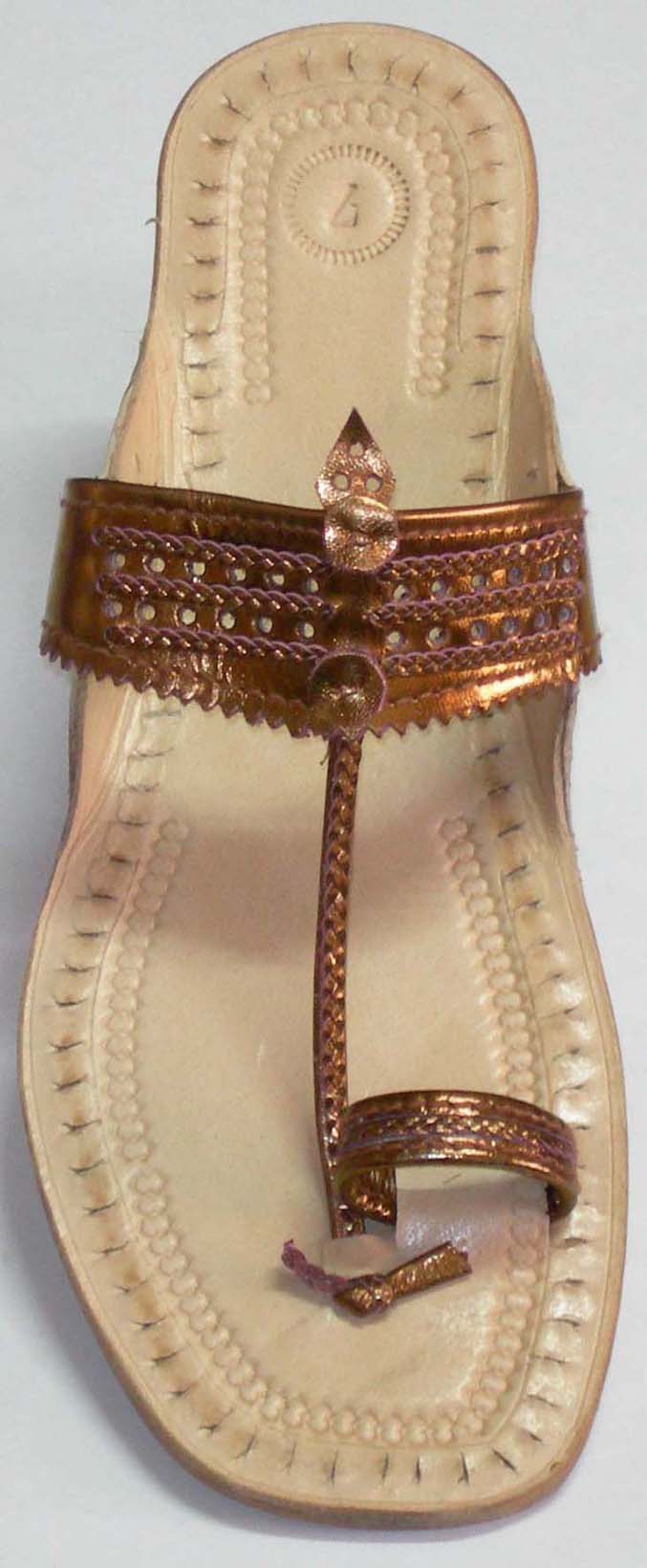
Kolhapuri Sandal
Not Size 44 or Smaller
If you are not comfortable with a 44, we will need to have something made for you. This task is not as daunting as it sounds as there are plenty of high quality custom tailors around town. Unfortunately, you are not in town, so you will need to rely on our discretion to some extent.
To minimize the complications of custom tailoring, we are recommending a long-sleeve kurta with a mandarin collar, a floor-length sarong, and an accent shawl. The kurta and sarong are typically the same color, but we can mix it up if you’re interested. This outfit will run you about $100 all in.
Kurta with Sarong and Accent Shawl
Action Items for Men
First, based on your travel schedule, jacket size, and preferences, you need to decide if:Â
a) I’m shopping for you (size 44 or smaller, and either won’t be here on Sunday, March 14 or don’t want to shop),
b) you are shopping for yourself (by yourself or with the shopping group) on Sunday, March 14, or
c) you are opting for a custom-made sarong and kurta on my recommendation.
If you are opting for b), I’ll see you when you get here!
If you are opting for a), your action item is to provide the following information:
Preferred Colors
Jacket Size
Price Range with Maximum
Shoe size if interested
Tailored and structured -OR- Loose and roomy
Simple -OR- Intricate
Single hue -OR- Pattern
Preferred Designs
Geometric, floral, figurative ornaments, brocade, stripes
It would also be helpful to know what you don’t like. For instance, I hate paisley. Any hints are appreciated.
If you are opting for c), your action item is to provide the following information:
Favorite colors
Jacket size
Height and Weight
Price range with maximum
Shoe size if interested
Neck — Measure around the neck with one finger inside the measuring tape
Full Shoulders — Measure shoulder-to-shoulder across the back
Sleeves — Measure sleeves from the seam on the shoulder to the wrist (or length desired)
Chest — Measure around the chest well up close to the underarms
Inseam — Measure inseam to one inch from the ground
Outseam — Measure true waist to one inch from the ground