We had not planned on stopping in the Dominican Republic so when we landed at Puerto Plata, we had no idea what to expect. As Andy mentioned, the engine had been losing revs. We held our breath as we motored slowly (with periodic engine coughs) through the reefs with breaking waves on either side, and steered past the exposed remains of a wrecked ship that failed to heed the chart’s advice regarding the narrow channel. Furthermore, nobody ever answered our radio calls. Usually, boats can call a harbor master, marina, another boater, somebody, on VHF channel 16 to get information on how to proceed and what to expect.
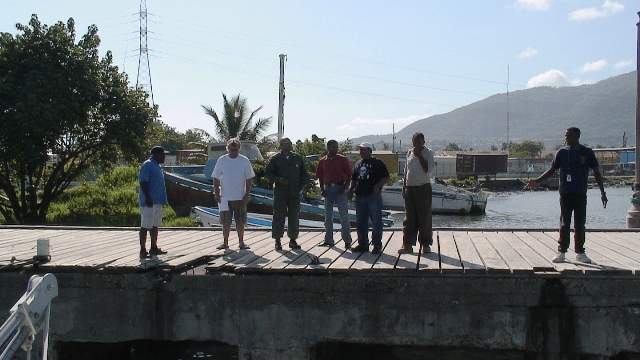
As we approached however, it became clear that dock workers were in fact waiting for our arrival. A tug boat traversed the channel entrance and lots of guys stood on the closest point yelling instructions for us (in Espanol, but pointing and arm waving worked fine too).
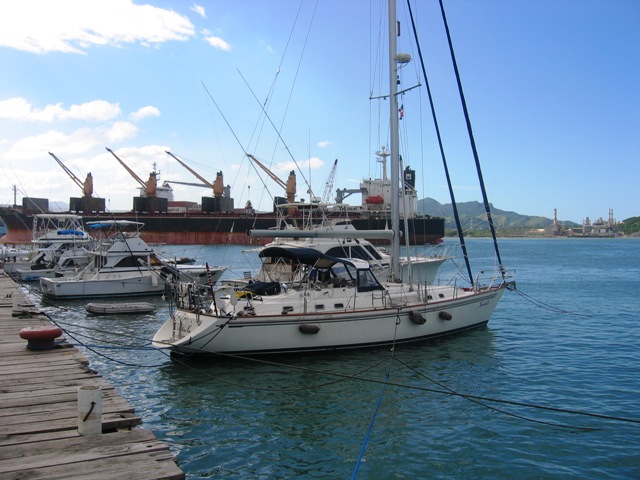
Coming around the bend, we noticed that all of the smaller boats were med-moored, just as our onboard copy of Reed’s Caribbean Almanac indicated. We were a bit nervous, having never performed this procedure before, but we read up on it and made a plan of attack. Luckily, the dock workers gestured that we should land any way we possibly could … which we did.
Almost exclusively for commercial use, the old dock is basically a concrete slab — no marina, no mooring balls, no floating docks, no finger piers, no pilings, no nothing. Way too high and only sporadically brandishing some old tires for protection, this dock is not well suited for a boat like ours. Spectacle stuck out conspicuously among the fishing boats, tugs, and freighters. Plus, we quickly realized why most boats were med-moored … a significant surge in several directions depending on tide and time and day.
Nonetheless, the dock workers helped tie us up with multiple lines, including spring lines which are docking lines that help stabilize the boat’s movement. For instance, an “after bow spring line†attaches near the bow, runs aft, and attaches to the dock preventing the boat from surging forward. Another example: a “forward quarter spring line†attaches to the quarter of the boat, runs forward, and attaches to the dock near the bow of the boat preventing the boat from surging backwards.
About this time, we met our all-purpose “fixer,†Roberto, who will be described in more detail later. Roberto promptly hired a night time boat-sitter for security purposes (the boat-sitter frequently had a humongous gun) and to watch the lines.
The next morning, we awoke to a loud crash towards the bow that sounded like another boat had hit us. We jumped out of bed to find that the surge had pounded us into the dock. Luckily, it was the bow anchors that were hitting, causing the sound to be worse than the pound, but still, we were a little confused as to how we could be hitting the dock even with the huge surge.
In any event, we sprang into action to tighten several lines and lessen the swing towards the dock. It was a difficult task because of the tremendous load on the lines, so coordination and finesse were required as the swell periodically, but only briefly, slackened the lines. In the mean time, we attracted an audience of French Canadian tourists waiting for their deep-sea fishing expedition to begin. Several were actually videotaping our little drama unfold, and since we had just jumped out of bed, we were both in our underwear (be watching for us on “Montreal’s Funniest Home Videosâ€).
After the significant effort to tighten the lines, we realized that the night time boat-sitter had rearranged a strategically placed and vitally important spring line. This error is what caused us to surge forward (incorrectly slackening the other spring and dock lines) and consequently, bash into the dock. To add insult to injury, the just completed fixes rendered the replacement of the incorrect, but still necessary, spring line impossible. The surge kept growing stronger and stronger. Finally, it caught us just right, smashed us fairly hard into the dock, and damaged the rub rail. At this point, Roberto the “fixer” suggested a med-moor situation, which he seemed confident to be able to achieve even with our flaky engine and shaky electrical system.
Because picking up the anchor and the anchor chain would be extremely difficult without the electric windlass, Roberto and Andy headed to the hardware store to pick up some lighter weight anchor rode. They were only gone for about 30 minutes, and in that time, a spring line snapped like a piece of thread under the massive load. Luckily, I was able to replace it without another crash into the dock.
With the confidence and leadership of a true Captain, Andy put on his negotiator hat telling Roberto 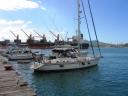 exactly what needed to be accomplished, how much it would cost, and who would be ultimately responsible for the result. When all parties were satisfied with the agreement, Roberto and his team went to work to med-moor Spectacle, and Andy and I went to lunch. Upon our return, Spectacle was in a much safer situation – stern perpendicular to the dock, two anchors off the bow keeping us off the dock, two stern lines keeping us close enough to the dock, and two stern spring lines to keep us from swinging too far laterally. Disaster averted. Or so we thought …
Being at anchor, med-moored, in a significant surge, against a concrete slab, is not exactly conducive to a good night’s rest. After awhile though, we relaxed and realized that Spectacle was pretty stable. The likelihood of both anchors dragging was low especially since the sea floor sloped sharply and a loose anchor would simply drag uphill and easily re-bite. Furthermore, Roberto admonished the night time boat-sitter and checked the lines personally.
Several days later, I woke up early, started some coffee, and began to enjoy another beautiful sunny morning in the Dominican Republic when I heard the unmistakable sound of an anchor dragging across the ocean floor. I ran up on deck to find an approximately 60-foot-long, beat-up, third world, commercial cargo boat attempting to slip in to the dock beside us and dragging our anchor with it. I yelled and gesticulated frantically, confirmed that the other anchor was still intact, and grabbed Andy out of bed.
 At first, the crew on the cargo boat stared at me blankly wondering why I was acting like such a crazy person. Then, a guy emerged from the cabin wearing a speedo (that was threadbare and white, yikes) and donning a mask. The swimmer dove several times, coming back up for air and providing updates in Spanish. Another guy came from the cabin and handed the swimmer a butcher’s knife. The next thing we saw was a different guy splicing our anchor line back together.
Needless to say, we were absolutely livid. If both anchors had dragged, we probably would have been up against the dock with few good options and precious little time. Roberto talked to the Captain who said that they “didn’t see the line.â€Â We found that pretty hard to believe for a number of different reasons: a) both anchor lines are conspicuously colored bright red; b) every boat at the dock is med-moored so obviously there’s gonna be anchor lines off the bow; and, c) they landed at the only available dock space without a rafting situation (so they wanted to be directly on the dock to unload their cargo and they didn’t really care who or what was in their way).
Now some of you might be saying to yourselves, oh Melissa and Andy . . . don’t be so crotchety . . . accidents are bound to happen and I’m sure they didn’t do it on purpose! I thought that too for about one hour when the next cargo boat to come in did the exact same thing … ran over the anchor line, dragged the anchor under their boat, cut the line without asking, spliced the line back together, haphazardly reset the anchor, and called it all a huge accident.
 It was then that we decided to move to the closest proper marina as soon as possible. As much as we were enjoying Puerto Plata, the safety of the boat needs to be the first concern and  we worried about the surge and the next round of cargo ships to land. Plus, we knew that after the two incidents, it was back to sleeping with one eye open and being exhausted all of the time when there was still much work to be done. So we informed Roberto of our impending departure and said goodbye to our new friends as we researched other places to park our floating condo.
We originally thought that Luperon was our closest option. Famous among cruising types, Luperon is one of the best naturally protected harbors in the entire Caribbean and many cruisers spend all of hurricane season anchored and well sheltered there. Unfortunately for us and the inconsistency of our electric windlass, Luperon is mostly an anchorage area. One marina has only about ten slips (and I never was able to find a working phone number for them anyhow), and another marina is still under construction. That’s when we learned about Ocean World – the two-month-old marina, casino, and marine adventure park only about 10 miles away. And Ocean World could not be more different than the old dock. More Pictures

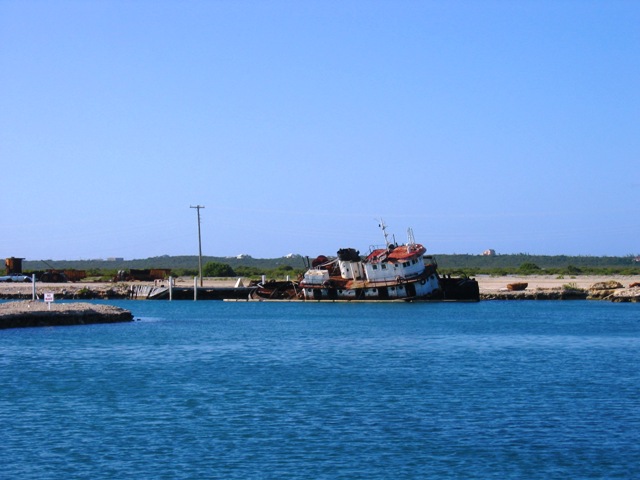 guidebook published in 1999 describing the Caicos Marina and Shipyard as the up-and-coming marina of the entire Caribbean … hundreds of slips planned, along with state of the art facilities, blah blah blah. Imagine our surprise when we were instructed to raft to another boat (still charged full fare), found out that the laundry machine was broken, and noticed the lovely view of half-sunk, half-rusted-out industrial equipment.